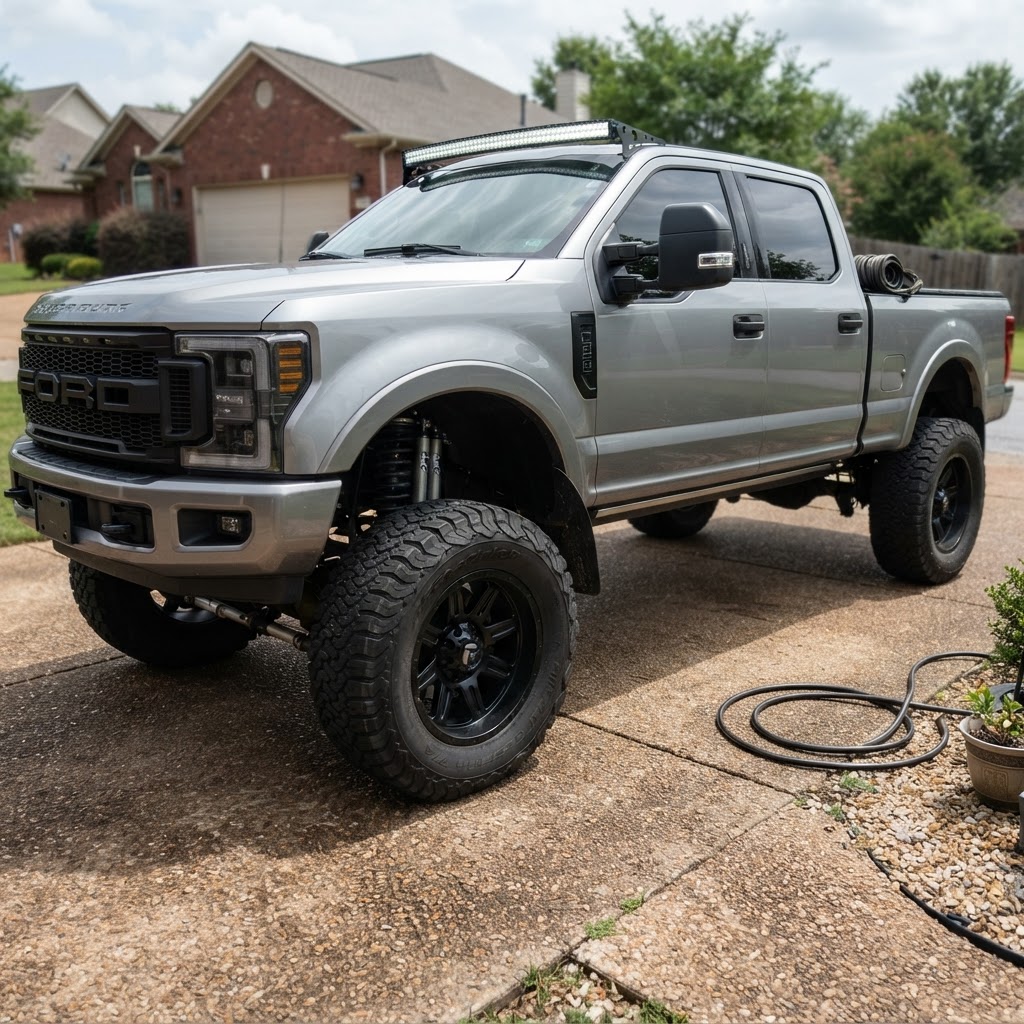
Ford Super Duty Hitch Guide: Conventional, Fifth-Wheel & Gooseneck
The best hitch for a Ford Super Duty depends on the trailer, not on which hitch has the biggest number printed on the box.
Ford Super Duty pickups support conventional, fifth-wheel and gooseneck towing, but the truck's actual rating changes with model, engine, axle ratio, cab, bed, drivetrain, wheel configuration and installed equipment.
The truck rating comes first
Before shopping for a hitch, identify the exact truck:
- F-250, F-350 or F-450
- Single rear wheel or dual rear wheel
- Gas or diesel
- 2WD or 4WD
- Cab and bed length
- Axle ratio
- Factory towing or prep packages
Ford's 2026 towing guide lists configuration-specific limits. The highest advertised number does not apply to every Super Duty.
Conventional receiver hitch
A conventional trailer connects behind the bumper through the receiver.
Common uses include:
- Equipment trailers
- Enclosed cargo trailers
- Boats
- Utility trailers
- Travel trailers
The receiver, ball mount, hitch ball and trailer coupler all need ratings appropriate for the loaded trailer.
The lowest-rated component controls the system.
Tongue weight matters
Ford's 2026 towing guide says conventional trailer tongue load is generally expected to be about 10 percent of loaded trailer weight.
That tongue weight sits on the truck and consumes payload.
Example:
A 12,000-pound loaded trailer at roughly 10 percent tongue weight can place about 1,200 pounds on the truck before passengers, tools or other cargo are counted.
Always use the actual trailer and manufacturer guidance rather than treating a percentage as a substitute for proper loading.
Weight distribution
Some trailer combinations use a weight-distributing hitch.
Ford provides guidance for front-axle load restoration when load bars are used.
Do not assume a weight-distributing hitch increases the truck's GVWR, rear GAWR or payload.
It changes how load is distributed through the combination; it does not rewrite the vehicle ratings.
Fifth-wheel hitch
A fifth-wheel hitch mounts in the pickup bed over or near the rear axle.
It is commonly used for:
- Large RVs
- Specialty trailers
- Heavy recreational towing
Ford lists maximum available fifth-wheel towing separately from conventional and gooseneck towing.
For 2026 Super Duty, Ford advertises maximum available fifth-wheel capacity up to 35,000 pounds on properly configured trucks.
That is a maximum for specific configurations, not a universal F-250/F-350 rating.
Fifth-wheel pin weight
Ford's guide uses about 15 percent as a typical fifth-wheel or gooseneck loading reference.
Pin weight can consume payload quickly.
A large trailer may be within a published tow rating while still exceeding the truck's payload or rear-axle rating once passengers, hitch hardware and cargo are added.
Gooseneck hitch
A gooseneck trailer couples to a ball mounted in the bed.
Typical uses include:
- Livestock trailers
- Equipment trailers
- Flatbeds
- Commercial hauling
Ford advertises up to 40,000 pounds maximum available gooseneck towing on the 2026 Super Duty when properly configured.
Again, the individual truck may be rated much lower.
Factory prep package
A factory fifth-wheel/gooseneck prep package can simplify mounting because the under-bed structure and attachment points are designed for compatible hitch hardware.
Before buying a hitch, verify:
- Whether the truck has factory prep
- Bed length
- Hitch mounting system
- Trailer kingpin or coupler type
- Required clearance
- Hitch rating
- Truck-specific rating
Bed clearance
Fifth-wheel and gooseneck setups need adequate clearance between the trailer and:
- Cab
- Bed rails
- Tailgate
- Hitch hardware
Short-bed trucks may require additional consideration for cab-to-trailer clearance.
Ford's towing guide specifically includes tailgate-clearance information for fifth-wheel and gooseneck towing.
Payload is often the limiting factor
Tow rating is only one number.
Also check:
- GVWR
- Front GAWR
- Rear GAWR
- Payload label
- GCWR
- Hitch rating
- Trailer GVWR
Passengers, hitch hardware, cargo and pin/tongue weight all count.
Hitch installation
Use hardware and mounting instructions approved for the exact truck and hitch.
After installation verify:
- Fastener torque
- Safety-chain attachment
- Electrical connector
- Breakaway system
- Trailer brakes
- Bed clearance
- Coupler engagement
Bottom line
Choose a Ford Super Duty hitch based on the trailer type and the exact truck configuration.
Conventional hitches work for bumper-pull trailers. Fifth-wheel and gooseneck systems move the connection into the bed for different trailer designs and higher-capacity applications.
The hitch rating matters, but the truck's GVWR, axle ratings, payload, GCWR and configuration-specific towing limit still control what the complete combination can handle.