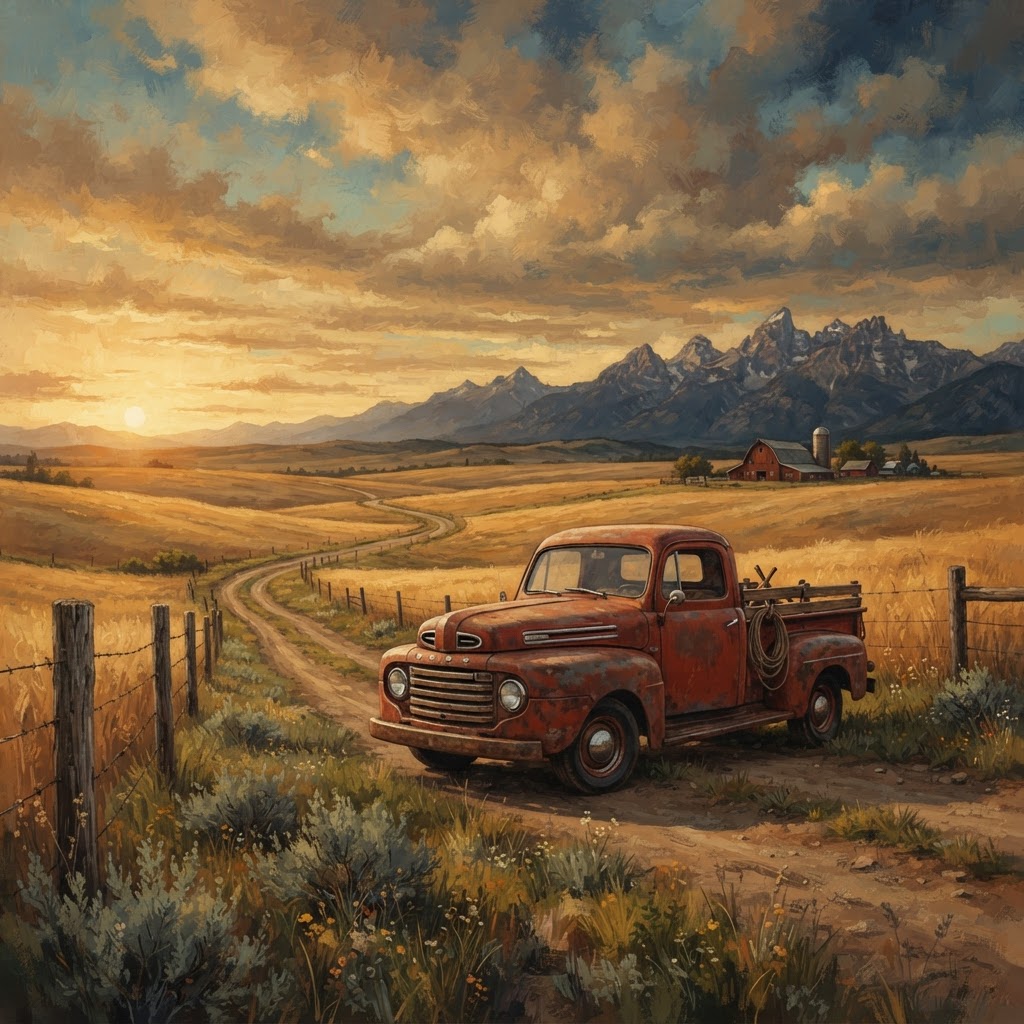
The heat in Montana doesn’t just sit on you in July; it hums. It comes off the hood of the 1952 Chevy 3100 like a shimmering ghost, smelling of scorched metal and old oil. I was six years old, wearing denim overalls that still had the factory stiffness and a pair of Keds that were already losing their white to the stubborn red dust of the ranch. Papa Jay stood over the fender, his shadow long and steady against the gravel. He didn’t look like a man who spent his afternoons chasing ghosts. He looked like a man who was made of iron and patience. He reached into the cavernous space under the hood and pulled out a wrench, a heavy piece of forged steel that felt like a club in my small hand. Here, he said. Not a question. Just a direction. The truck was a sun-bright yellow, peeling in places to show the gray primer underneath, like a scab you were tempted to pick at but knew better. It was the only thing on the property that mattered. It was our heartbeat. I looked at the wrench, then at the oil pan beneath the chassis. I wanted to ask if I was going to break something, but I had learned early on that Papa Jay didn’t deal in hypotheticals. He dealt in what was happening right then, in the present tense. I crawled under the truck. The ground was packed hard, cool where the shadows of the engine block fell. Above me, the massive engine ticked as it cooled, a metallic rhythm that sounded like a slow, steady pulse. Slide the pan under the bolt, he said from above. His voice was gravelly, the sound of boots on a dry road. Don't rush it. I slid the black tin tray into place. It scraped against the dirt, a sound that made my teeth ache. I reached up with the wrench. My fingers were slick with grease, making the handle slicker. I found the nut. It was stubborn, tight from a year of highway heat and winter ice. I pulled. My muscles, small and underdeveloped, burned with the effort. Papa Jay didn’t offer to take it from me. He just watched. Finally, the nut gave way with a sharp, metallic crack that echoed in the quiet yard. I didn’t pull it away fast enough. The oil came out in a dark, viscous stream, hot and thick as molasses. It caught me by surprise. I jerked my hand back, and the bolt—the plug—slipped from my slick fingers and vanished into the black pool. I froze. The sound of the oil hitting the bottom of the pan was deafening, a wet, rhythmic splashing that felt like a ticking clock marking my failure. I waited for the yell. I waited for the lecture about being careless or clumsy, the kind of things I heard when my mother was around. But the yard stayed quiet, save for the distant cry of a red-tailed hawk circling the ridge of the mountains. Papa Jay knelt down, his knees popping like dry wood. He didn't look angry. He peered into the pan, his face a map of lines and sun-spots. Well, he said, his voice flat and dry as sagebrush. I reckon that bolt wanted to go for a swim. He reached into the oil with his bare hand, unfazed, and plucked the plug out. He wiped it off on a rag that was already stained blacker than the oil itself. It happens, Jake. The trick isn't keeping it from happening. The trick is knowing how to get it back. He handed me the plug, his skin feeling like tanned leather against my palm. Put it back in. Don’t cross-thread it. I did as I was told. I felt the threads catch, smooth and sure. I felt a strange, quiet pride rise in my chest, a feeling that had no name but felt like solid ground. For a few hours, the ranch was just this: the smell of diesel, the heat of the sun, and the way a man could look at you and decide you were worth the time it took to teach you something. The sun began to dip behind the peaks, turning the sky the color of a bruised plum. The shadows stretched until they swallowed the barn. A dust cloud appeared at the end of the long driveway, a low, tan plume that announced a visitor long before the vehicle emerged. It was my mother’s sedan, silver and out of place against the backdrop of the rugged hills. She didn’t stop at the shop. She pulled up near the porch, the engine clicking as it shut down. My mother stepped out, her movements sharp, her hair caught in a sudden breeze. She didn't look like she belonged to the ranch. She looked like she was visiting a museum she didn't care for. I stood by the yellow truck, my hands coated in black, waiting for a sign. Papa Jay wiped his hands on his trousers, his movements slow and deliberate. He didn't look at the car. He looked at me. Go on, he said. His voice was soft, barely a breath. But stay steady, Jake. I walked toward the house, my boots crunching on the gravel. I could feel the weight of the day in my limbs, the exhaustion of learning. I expected her to scoop me up, to tell me we were going back to town, to the life I barely remembered. Instead, she stood by the driver’s side door, her purse clutched in both hands like a shield. We didn't talk about the ranch. She talked about the drive, about the city lights, about a life that moved too fast for the dirt roads of Montana. Her eyes kept drifting to the horizon, never landing on me, never really seeing the grease on my hands or the way I held my shoulders, trying to be as still as Papa Jay. When the sky turned fully dark, she climbed back into the car. I stood on the porch, my toes curled into the weathered wood. She didn't wave. She didn't cry. She just turned the key, and the headlights flickered to life, two harsh, white beams cutting through the gloom of the yard. As she shifted into gear, I felt a sudden, sharp coldness, the kind that only comes after the sun has completely left the mountains. I didn't run after her. I didn't call out. I stood there, rooted, watching the tail lights grow smaller and smaller, two red pinpricks of fire drifting away from everything I knew, until they vanished into the darkness beyond the pavement.
Related truck guides
Pickup Truck News or Stories
Where the Pavement Ends — Chapter 2: The Rules of the Shop
On a Montana ranch, a young boy learns that integrity is the most important tool in the shop, even as his grandfather's hidden scars begin to show.
Pickup Truck News or Stories
Top Pickup Trucks of 2025: A Comprehensive Overview
Explore the top pickup trucks of 2025, including full-size, mid-size, compact, and electric models, with expert insights and recommendations.
Pickup Truck News or Stories
Top Electric Trucks: Recent Developments and Implications for Truck Owners
Explore the latest developments in the electric truck industry, including new model releases, strategic shifts by major manufacturers, and what these changes mean for truck owners.
Truck Reviews & Comparisons
The Best Work Trucks for Contractors: 2026 Ultimate Guide
Looking for the best work trucks for contractors in 2026? We break down the top pickups for power, payload, and reliability to keep your business moving.
COMMENTS (0)
to join the conversation
No comments yet. Be the first to share your thoughts!